
Mueller Water Products is a leading manufacturer of products and services used in the transmission, distribution, and measurement of water and gas. With more than 3,500 employees and a legacy spanning over 160 years, Mueller plays a critical role in North America’s water infrastructure and safety systems, supplying municipalities and contractors with the tools they need to control flow and protect communities.
At their Decatur, Illinois facilities, Mueller operates both machining and heavy metal casting operations, including the largest brass foundry in North America. Their products are mission-critical: when a valve or fitting fails, the result isn’t just a product defect, it can disrupt water and gas flow for thousands.
When Mueller made the transition from its century-old foundry to a brand new, state-of-the-art facility, it wasn’t just a physical shift. It was a seismic knowledge transition.
Longtime employees, some second and third generation, retired en masse, taking decades of experience with them. The new workforce was younger, less experienced, and walking into a high-risk environment with molten metal, grinders, and repetitive motion tasks.
Standard work existed, but only in fragments, i.e., Word docs, tribal knowledge, and outdated PDFs. Verbal training and learned-on-the-job practices led to inconsistent execution, high injury potential, and scrap variability
Mueller knew that starting fresh was an opportunity. With a new facility and new faces, leadership made a strategic decision: use Dozuki to digitally document, deliver, and enforce frontline knowledge, especially in high-risk operations.
They invested in tablets across stations, launched video-based standard work, and started training their utility workers to operate like “infielders,” able to move between roles safely and confidently with on-demand guidance.
The team prioritized:
They also launched:
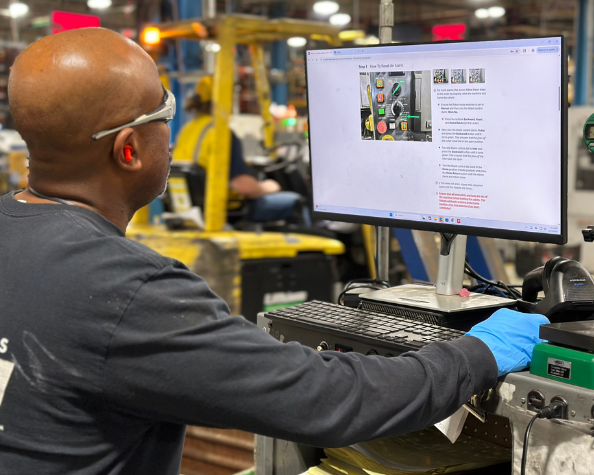
With Dozuki, Mueller achieved measurable safety and quality outcomes, without slowing down production. With 20% reduction in injuries in high-risk areas, 60% reduction in scrap as training consistency improved, and hundreds of operator comments driving continuous improvement wins.
The impact didn’t stop in Decatur. Mueller’s success is now a template for scaling connected worker training across its other U.S. facilities, with plans to expand Dozuki to machining, assembly, and global manufacturing partners.


.png)


