Airstream reduced turnover by 83% with Dozuki.
Watch the VideoSee how Costa Farms unified their process documentation across nine production sites with the Dozuki Connected Worker Platform. This updated multilingual system supports thousands of employees and seasonal workers across operations.
Scott: Welcome to another edition of the Dozuki Customer Success Stories. Today, we're featuring Costa Farms, one of the largest horticultural growers in the world. They face the challenge of unifying standards across multiple countries, languages, and facilities. Today's session you won't want to miss. They'll be sharing what changed, how they got there, and what it meant for connected workforces in their environment. The Costa Farms team, the floor is yours. Take it away.
Carlos Peña: Thank you so much for inviting us to participate in this webinar and to share the experience that we are having with Dozuki over the past almost two years. Okay, I need to present the team. With me in this webinar is Yehudy Sanabria, one of our process engineers in South Carolina, and also Paul Rodriguez, our senior process engineer operation in Costa Rica, in Santa Florida.
Carlos Peña: To tell you a little bit about the problem we had, or why we introduced and implemented Dozuki in our company: Costa Farms is a global horticulture leader with a large-scale operation across the U.S. and Dominican Republic. We grew very, very fast, and as we grew, we tried to identify ways to standardize the processes and documentation we have inside our company.
Carlos Peña: As the company expanded, paperwork flow and language barriers—because we speak different languages inside the company—made it hard to maintain consistent training and standardization of the documentation we handle. Basically, a couple of years ago, the intention was to look for a platform that provides us a way to reduce or eliminate paper in some of our processes. It also helped maintenance to leverage the level that we had at that moment, and provided a better way to document and create accessibility to the documentation inside the different sites across the U.S. and Dominican Republic.
Carlos Peña: Major challenges we found: every site operates as an island, very isolated, with limited access to documentation and information. Also, the majority of information was documented on paper or in a computer, with very difficult accessibility for those not working in the specific location. We tried to use different ways to share information and create accessibility, like SharePoint, but we didn't have very good results in the past. The other challenge was the approval process. In the past, the approval process basically used back-and-forth emails to create an approval. People created the documentation, sent it to the approvers. And then we had a very long time, or we needed to wait for a long period of time, to obtain responses. Also, the technician and the operator were very overwhelmed to have all this information on paper, and we spent a lot of time on data entry because the majority of paper information later needed to be transferred to a computer when we had a checklist inside the maintenance or process department. The other big challenge was the terminology and the language, because everybody used different terminologies, and this created big issues in communication. Even when we used similar languages, people used different terminology, and this was very complicated to provide very good support.
Carlos Peña: The old way of training before Dozuki—I think Yehudy and Paul can explain this better because they are working very hard to improve training and documentation inside Costa Farms.
Yehudy Sanabria: Well, hi, my name is Yehudy Sanabria. As Carlos mentioned before, it was really challenging to have all the SOPs in paper format. I think this quote really represents the real meaning of what happened in the past with the SOPs. The SOPs were basically dead because we were never able to find them. And if we did find them, they were not updated, or sometimes not the recent version. Can you go to the next one, please?
Yehudy Sanabria: So, we had all our SOPs printed in binders. It was really difficult to find, or they were missing or weren't updated. We used to use just email, and it was really hard because sometimes you expect this process is approved in the email. But when you received the email, it was, "Oh, it looks okay," and you answered, "Is it approved, or is it not approved?" It was really unclear. I think one of our major challenges is that our main languages in the company are English, Spanish, and Creole. So, when you create a PowerPoint SOP, when you create it in one language, you have to translate it into the other two languages. If you change something—a photo or you improve the process and you need to improve the SOP—you also have to do it in the other two languages. So, it is really rework and a waste of time, basically. All the technicians just used paper format. This meant they had to go and print it, fill it by hand, and type the results into an Excel spreadsheet. It is a lot of rework involved in all this process.
Yehudy Sanabria: We have, if I'm not mistaken, nine different locations. This means every location had its template. They could have different formats: one uses Excel, another uses PowerPoint, another uses Word to create the work instruction or SOP. We tried to use version control, but it was really hard to keep it up. For collaboration, as Carlos mentioned, if we have the document on SharePoint, one location doesn't have access to the other location's SharePoint, so collaboration in that part was really hard, and also guide ownership. Also, in the past, different locations, for example, for safety equipment, had different formats to inspect the equipment, so it was really challenging.
Yehudy Sanabria: Now, we are not duplicating documents. We are collaborating on one company-wide guide. A really good example of this is we have new equipment that we started using last year. Instead of every location having different documents for the same piece of equipment, right now, we are working on just one document for all the locations. It is really nice to be contacted by other co-workers in another location, asking, "Can we improve this guide?" Obviously, you try to do your best the first time, but having another couple of eyes looking at your guide and seeing how you can improve it makes it better at the end for the team who use the guide on the floor.
Yehudy Sanabria: Right now, we are creating over 1,000 guides in less than 18 months. We are using QR codes. In that way, our connected operators have easy access to our work instruction, SOP, inspection through virtual touring, changeovers, maintenance, and safety. We start tracking everything in a dashboard. The digital approval, I think, is one of the big improvements because everything is tracked step by step: who is pending and who is still missing to approve the document. The translation is another feature we love because you only have to create the document in one language, and you don't have to translate. This also includes when you update a picture; it's really easy to just edit, and that's it. You don't have to change two more files. As I mentioned before, instead of duplicating documents, we try to use one document for all uses. What we are working on right now is just trying to standardize the process for the same equipment across all our operations in all OUs.
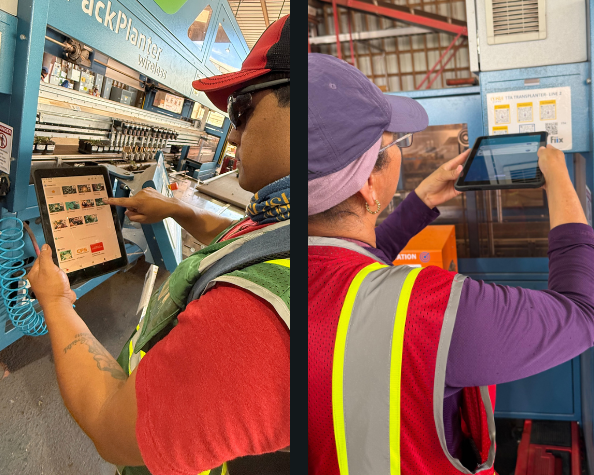
Yehudy Sanabria: In this example, we can see the QR code. This is a transplanter machine, and basically, we have all the SOP. We have the troubleshooting. It's really easy to access for the operator because, as we can see in the next photo, they only have to scan the QR code, and they have really easy access to all the documents.
Yehudy Sanabria: This photo is from the Dozuki visit about a month ago. The operator was sharing his feedback about how Dozuki was working for us in the company. This is another photo. It is really easy to adopt by the operator. I mentioned the other day that now the operator is the one who asks, "Where is my QR code? I need a QR code for this equipment." It is really nice that now I don't have to say, "You have to use this." No, they ask me because they actually find how easy it is to use the QR code, scan it, go step by step, and that's it. They don't have to save a form; they don't have to go to an Excel spreadsheet to type the information. Everything is really easy for them right now.
Paul Rodriguez Jr.: Alright, next, we want to talk about our implementation that we've done here at Costa Farms. One of the biggest things we saw was that it wasn't about convincing the teams that they needed to use Dozuki; it was about getting them to start the documentation. That was probably one of our bigger challenges.
Paul Rodriguez Jr.: Regarding training after Dozuki, we generated a pilot program focusing on the highest value assets. Doing that first is where we could find the most value. This included some of the most important critical machinery for both the maintenance side and the operator side. This is what generated the positive outcome in some of the users to continue generating more Dozuki content.
Paul Rodriguez Jr.: We successfully rolled out across production, maintenance, safety, and training. This was a great strategy because these are some of the core concepts and core areas we have in the business. By tackling the core, you can really build a strong foundation. There wasn't any resistance to using Dozuki as a tool. A lot of the employees and the management team found that this was a great tool, and it definitely helped expedite our work. The part that created resistance was just building that documentation. As we operated in silos or islands throughout the company, we all had our own different processes and ways of doing things. A lot of the teams rely on tribal knowledge. We just keep it in our heads, and we don't really have it documented.
Paul Rodriguez Jr.: That was probably one of the harder things to convince people: "Let's start documenting it." Once we documented it, they saw the value in it. They can go on vacation, right? And enjoy themselves, and not worry because the documentation is handled properly. And also, people are able to access that documentation. It's not in some random, hard-to-find SharePoint list, or written down in different areas. It's right here, to the point, available to them using QR codes.
Paul Rodriguez Jr.: Who helped with this training? The leadership and development team and engineers supported the first few guides. We set that great foundation to leverage our great team members to build more and more. The workers embraced the tools once they saw how easy it was to access the content. As I said, by using QR codes, and also by utilizing tags within Dozuki, we were able to virtually duplicate different guides to different areas so that teams don't have to click around to specific points in Dozuki. It's right where they need it, anytime. Lastly, with QR codes, it turns the supervisors into advocates. Why? Because when we had paper documents, it was a lot harder for us to flip through something. The QR codes are available at a specific machine or work area so we can use them for training, checklists, or even doing things like preventive maintenance on those machines. It's a great help for us.
Paul Rodriguez Jr.: So, our learnings. What we found while we were using Dozuki is that you don't need to have a polished, perfect document, because at the end of the day, nothing's perfect. We just want to get started. Write down information, get a good structure in, and then we can build on it as we find different opportunities. That helped us create a lot more documentation, and a lot more teams became involved in the Dozuki process.
Paul Rodriguez Jr.: So, what are some of the best practices that we found using Dozuki? First, we started with the high-impact items and high-impact processes. That was probably our most beneficial approach. High-impact processes allowed us to leverage the most important parts of the business and involved a lot more team members so they could see the impact of getting proper documentation. We didn't want to wait for things to be perfect. We documented collaboratively and improved on it later. As we created more documentation, teams were involved more and more, and they were able to provide great feedback. Maybe there was an aspect in the documentation that you missed in the training, and by having more team members involved, they can review it so we can improve that documentation. If we tried to be perfect on that documentation, it would have taken a lot longer to generate content, and fewer people might have been involved.
Paul Rodriguez Jr.: Next, we translated it once and not three times. Utilizing the built-in language tools within Dozuki was a great benefit for us, as Yehudy mentioned. I am a native English speaker and not proficient in Spanish, but most of our workers speak Spanish. Writing something in English and translating it to Spanish might not be correct, and we'd have to go back and forth. It took me a lot of time just trying to figure out the right translation. By using Dozuki, we were able to easily share language, and all the different documentations were available in everyone's own language, which really sped up that process instead of going back and forth.
Paul Rodriguez Jr.: Next, we leveraged the site admins to drive consistency across sites. Because we were in different islands, one location might be creating a maintenance guide for a golf cart, and another is doing a different guide. By using Dozuki, we were able to have all these admins work collaboratively to then make one guide together. Ultimately, the best way for the company is if we're going to do a guide on the maintenance of a golf cart, it should be the same no matter what site we're at. So, by the admins working together, we have one guide to build instead of nine different ones, which took a lot longer.
Paul Rodriguez Jr.: We want to foster content, not ownership. We don't duplicate these ideas or different guides; we borrow them. As Yehudy might be working on a guide in her area, I might find that really useful for my team, as we might have the same equipment, and vice versa. That really did expedite our process as well. Lastly, we had the metrics. We were able to immediately see the amount of guides the users were creating. We were able to see how much time we saved by writing it in Dozuki and using the auto-translate. Giving the teams easier access via QR codes versus going through pencil and paper resulted in a much, much better improvement.
Carlos Peña: Some of the impact we obtained after the implementation of Dozuki inside of operation. One of the biggest reductions is the time that operators and technicians spend looking for information. In the past, they needed to walk around the shop floor, looking for a binder and big folders, trying to find information and making sure that information was in the correct language they could understand. We went from 7.5 minutes to 2.5 minutes—basically a 65% reduction in the time an operator needs to find the correct information. Also, for people looking for information in the system, not directly on the shop floor, but using the Dozuki library, we reduced the time spent looking for information by 35% versus navigating different SharePoints and different folders. You can use Dozuki to go directly to search and easily find the information there.
Carlos Peña: Also, the time to create new content. I think Yehudy and Paul mentioned that we are creating more than a thousand documents in less than two years. This is basically because Dozuki provides a platform that is very simple and user-friendly to create documentation. The approval process is much simpler now than in the past, because instead of going through different back-and-forth emails, we now have a very clear and straightforward system to show who is pending approval, and who is the next in the approval chain. Because we eliminated the necessity to print everything on paper, we are reducing the time we need to create and publish new content by 47%.
Carlos Peña: Also, the workflow that in the past was around 45 days—from the moment you start creating a document until the moment you release it to the user—we can do it 80% faster, from 45 days to 9 days. And something we are testing right now with new metrics is the impact of Dozuki on reducing the time for data entry. As Yehudy and Paul mentioned, people are using Dozuki to create checklists for maintenance or equipment inspections. Now they can do it through a tablet or a mobile device, reducing the time that was previously spent transferring from paper to a computer. Our expectation is to reduce the time we spend in data entry by at least 50%.
Carlos Peña: Something we did at Costa Farms is we tried to identify customer satisfaction. When I say "customer," the internal customer for us is the operator, the final user. We created a survey and tried to obtain feedback from users at different levels, like operator, supervisor, and managers. We obtained 86% internal satisfaction with the tool. The key points that people highlighted are the language features, as Paul said: it doesn't matter if you speak English, Spanish, or Creole; you can create your document in only one language, and the system can do the translation for you. The other is accessibility, which is simpler now. And for me, a key inside the Dozuki implementation is the videos and the pictures that you can put into the devices, or into the work instruction, versus the old version on paper with tiny, difficult-to-see pictures. Now, in 5-10 seconds, you can watch a video that explains very well what the operator needs to do. This is one of the biggest wins of the Dozuki implementation.
Carlos Peña: What are the next steps we want to take inside Costa Farms? The majority of the Dozuki implementation has happened in Operations. Something we want to do is start implementing Dozuki and spreading the methodology and the new culture to other departments, like IT, Accounting, and Human Resources. Other departments can also use the benefits of the tool. We want to centralize information. We started working with very critical processes, and the majority of the documentation we created was for critical processes. Now we feel comfortable moving forward to processes that are not critical but that we want to keep documented, such as what we call seasonal processes, because they happen just during a specific time of the year. We want to expand the use of QR codes because they are working very well and are very easy for the operators to access the information they need. We want to use in Dozuki as one of the pillars, as a backbone for TPM and also for our Lean Manufacturing implementation. We want to continue to standardize safety practices across the different sites or locations in South Carolina, North Carolina, DR, Miami, Central Florida, and the location we have in Virginia. And we want to create the playbook: what exactly we need to do in the other departments to be as successful as we are and obtain the same benefits that we are obtaining in the Operations Department.
Scott: Carlos, Paul, and Yehudy, it's an incredible journey. The time savings are really extraordinary. And to be able to do that across languages, cultures, and facilities is a testament to the great work that you've done. During the presentation, each of you said some really interesting points that I wanted to resurface. Yehudy, you talked in the beginning about how you don't always get it right the first time. And Paul also said, "Don't wait for the perfect document." It sounds like continuous improvement is a big part of the culture, so I'd love to learn a little bit more about that and get your impressions.
Paul Rodriguez Jr.: Yes, definitely. Continuous improvement is one of the biggest pillars, especially in Operations. That's something that is pushed to everybody here. I know in my facility, we have yearly training to teach all leaders about continuous improvement. That's what I actually like about Dozuki. I'm a little bit of a perfectionist, so that was something I had to put in my head while we were trying to adopt Dozuki at our facility. By not having it perfect the first time, that was great because I got a lot more feedback from all these different users who are perfectionists in their specific area. I needed their input to build Dozuki. Having some type of base really helped bring it up.
Scott: Awesome.
Yehudy Sanabria: Also, when you have your operator involved in the process to create the guide, it really adds value when they say, "Now I'm not doing this as it's shown here. I changed the process a little bit because I found it was easier." In that way, we can standardize best practices when we have a new employee in the training process. That is important because at the end of the day, we can have new equipment, but if we are not able to document, we are not able to standardize, and we are not able to perform really good training. That is the reason our goal is to really work close to the operator to improve these guides.
Scott: Thanks, Yehudy. And Paul, you also talked about something interesting: how people can go on vacation and enjoy themselves and not have to think about work. Tell me more about that. Have you seen that in action?
Paul Rodriguez Jr.: Yes, over here, we have a lot of people who have been in the company for 20, 30, 40 years. They do this day in and day out. A lot of the work they do is not really documented well; it's just in their head. They train their apprentice or their backup on it. But what happens if they have to go somewhere else, or unfortunately, if they leave the company, and we need to train somebody else? By using Dozuki, one of the biggest opportunities we have is documenting all this knowledge they have, putting it on paper, and training it. I experienced it myself. I would have to do a backup process for somebody, and I'm not used to it; I maybe only did it once. So, we made a guide, step-by-step, showing what the process is, and then I utilized Dozuki to follow that to see what I would need to do for that backup. It's definitely a great connected worker platform tool, not just for the line level, but for management, leadership, everybody throughout the company.
Scott: Thanks, Paul. Carlos, you also said something I wanted to call out: you said the internal customer is the operator. Tell us about the advantage of thinking of employees in that way.
Carlos Peña: Yes, sure. Something we found in this journey with Dozuki is that sometimes when the engineer or the manager writes a documentation, they think of themselves, not of the final customer, which is the operator. They don't think about how the operator can absorb the information we are providing better. As Yehudy and Paul said, one of the most important things for success with Dozuki is the collaboration we have between operators and managers because one of Dozuki's functions is to provide feedback. We love that part—that people can provide feedback and you can receive a comment saying, "Oh, this is not the correct picture," or "This is not the correct information," and you can modify it. You never wait, because the perfect version never exists. If we wait for a perfect version, we can wait forever. With this, it's continuous improvement. Every time somebody reviews and uses it, it's even better. This is what we are looking for. This collaboration between different engineers—like Paul in Central Florida, Yehudy in South Carolina, and others in Virginia—allows them to collaborate to create a better version of the documentation. This is, for me, one of the biggest successes we are having with Dozuki inside Costa Farms.
Scott: Thanks, Carlos. And then the last question is for everybody, about seasonal products. Working in the horticulture business, many things only happen certain times of the year. What advice do you give to other manufacturing companies who work in seasonal businesses on how they can use a connected worker platform to solve that challenge?
Carlos Peña: Basically, in our experience, something that happens sometimes with seasonal processes or seasonal produce is that you put them at the end of your list. You procrastinate a lot because, "Oh, that will not happen until December," like Poinsettias for us right now, which is a popular plant people like for houses during Christmas. If you cannot document it at the correct time, what happens is everybody says, "Hey, we need to wait until next year, until next December, to create the documentation." But with the simple way we have right now inside Dozuki, you can create that document in 40 minutes. To be honest, in 40-45 minutes, you can create a very good document. This is convincing some people who had 20 years working with the company and used to say, "This is the way we've been doing it for 20 years. Why do we need to do it differently?" Now, with this tool, they found that it is very user-friendly, and it adds value to their team. They can transfer their knowledge very easily to this platform. I think this is the key: not waiting for perfection and not waiting until next year. Try to do it at the correct moment. It's not taking too much time to create the documentation. Also, it's very easy to use because it's very intuitive. It provides a very good guideline. You don't need to adjust the size of the picture or adjust the text because you deliver all the information there, and Dozuki provides the layout. My suggestion, based on our experience, is please try not to procrastinate on that and try to do it at the correct moment. Also, it enables delegation, because people can create content in different languages since they don't have to do the translation. You can find very good operators who can create content. Not only the engineers are creating content now inside Costa Farm; we also have some supervisors and technicians who are authors inside Dozuki.
Yehudy Sanabria: Additionally, about what Carlos mentioned, I think it is really important because it's a product you only do once a year. If you don't document it at that moment, probably in one year, you will forget what you did. What happens if you don't have the same supervisor, the same operator, or the same managers? If, for some reason, the headcount changed? If you don't have all this process documented, you will not be able to replicate what happened. A good example is with the poinsettia. We know it's a fragile plant when we are planting. This year, we started using dibblers to ensure the planting depth is the same in all the pots. But next year, if we don't document it, maybe people will forget how we did it last year. I think it is really important when we have a new process. Even when we have a new piece of equipment or machine, as soon as we receive it, we start documenting everything. If we have a one-week training with the technician, for example, if we don't document it at the moment, probably we will forget about 30% of all the information we got in one week.
Paul Rodriguez Jr.: Yes, and if I can add to that, you talked about the quality of the product by doing it seasonally. We might forget some of the things we have to do. By documenting, we ensure we use a tool like a dibbler to make sure we have the same quality on the product. That's one thing. Another thing would be productivity. By documenting the right process, we can make sure that our teams reach that same productivity standard, and maybe into the next year when we have to do that process, we can find ways to do continuous improvement. Another thing that nobody talked about is the safety aspect. For seasonal workers and seasonal processes, we sometimes have people working in areas they might not be used to. So, by documenting the proper ways to do it and the proper PPE, that's a great opportunity. You might forget that you have to wear safety glasses because something could go in your eyes. Those three key aspects are what a lot of manufacturing companies focus on, especially here at Costa Farms: safety, quality, and productivity. Documenting it definitely helps us with all three pillars.
Scott: Paul, Carlos, Yehudy, it's been an incredible journey. I know it's going to continue. You're in the business of growing both the team itself and the products, so it's an inspiring journey, and we really appreciate you taking the time to share with us today.