


.png)


There's the person who lives the daily friction, and the person who's never touched it.
This is the exact gap between your frontline and your executive team. Your operators are dealing with the manufacturing version of TSA lines every day: three people who didn't show up, raw material that isn't at the line, a machine that's down.
Your executives are thinking about growth and efficiency, the two levers that actually move profitability. They're not wrong to think that way. They're just not going to get excited about a changeover procedure.
Solving The Translation Problem
The instinct, when frontline teams want executive buy-in, is to explain the problem better, more detail, more context, more urgency about the work instructions or the training gap. That instinct is backwards. Executives don't need the problem explained better. They need it translated into a number they already think in.
Compare these two pitches:
“Our standard operating procedures are outdated and it's causing downtime.”
“45 minutes of downtime costs us $5,000 in profitability. We're experiencing twenty-four of those every month. Over a year, that's $1.5 million.”
The first sentence gets nodded at and forgotten. The second gets a follow-up question, usually “what do you need to fix it?” Same underlying problem. Only one version is stated in a currency the room actually trades in.
The Framework: OEE Is The Translation Layer
If you're trying to build that second kind of pitch, Overall Equipment Effectiveness (OEE) is the number to work backwards from. It's made up of three components, and each one has a direct line to a frontline lever:
We explored this distinction in our most recent Shift Change webinar: Availability, how much of the time the line is actually able to run. The three things that eat into it: changeover and setup time between SKUs, preventable breakdowns mid-run, and the time it takes to diagnose and repair when something does go down.
As Allen indicated, a connected worker platform's answer to each: documented, standardized changeover procedures so the team isn't relearning it every shift, pre-run checklists that catch the same failure modes before they cause a stoppage, and troubleshooting steps in the hands of the operator, so maintenance shows up already knowing what didn't work.
Performance, actual output against the line's ideal rate. The two losses here are minor stops (the line ramping up and stalling) and general slowness. The lever is visibility: recording a reason code every time the line stops, so you can see which failure mode is actually costing you the most instead of guessing.
Quality, scrap and yield loss, most of it traceable to how the operator was trained and how consistently inspection actually happens. The lever is training and skills management tied directly to the task being performed, not a separate onboarding module nobody remembers three months later.
Each of those three components rolls up into one number executives already track. That's the whole trick: you're not asking anyone to learn a new metric. You're showing your existing frontline problem already lives inside a number they report on every quarter.
The Capacity Problem vs. The Training Problem
Here's a story that shows what's possible when this translation actually happens, worth noting upfront that this one predates any connected worker software; it's offered as an illustration of the mechanism, not a vendor result.
A manufacturing facility needed more production capacity. The obvious fix was a new line: $1.5 million in equipment. But the facility was already at capacity, so a new line meant expanding the building too, construction, engineering, the works. Real number: closer to $3 million.
The facility had 11 lines that were all supposed to run identically, same equipment, same design, but didn't. Same throughput on paper, different throughput in reality. The variable turned out to be people: experienced operators diagnosed and fixed problems themselves; newer operators waited for a supervisor or maintenance tech to do it for them. That waiting time was the whole gap.
The fix wasn't new equipment. It was a skills matrix and deliberately mixing experienced operators in with newer ones across all 11 lines. Five months later: a 10% OEE uplift across the board, enough additional capacity that the $3 million expansion wasn't needed at all.
Compare that timeline to the alternative: ordering, shipping, and installing a new production line typically runs a year and a half to two years. Five months, using the people already on the floor, beat that by more than a year.
The point isn't the specific numbers, it's that the capacity problem and the training problem were the same problem, and nobody saw that until someone did the translation.
What This Actually Takes On A Monday Morning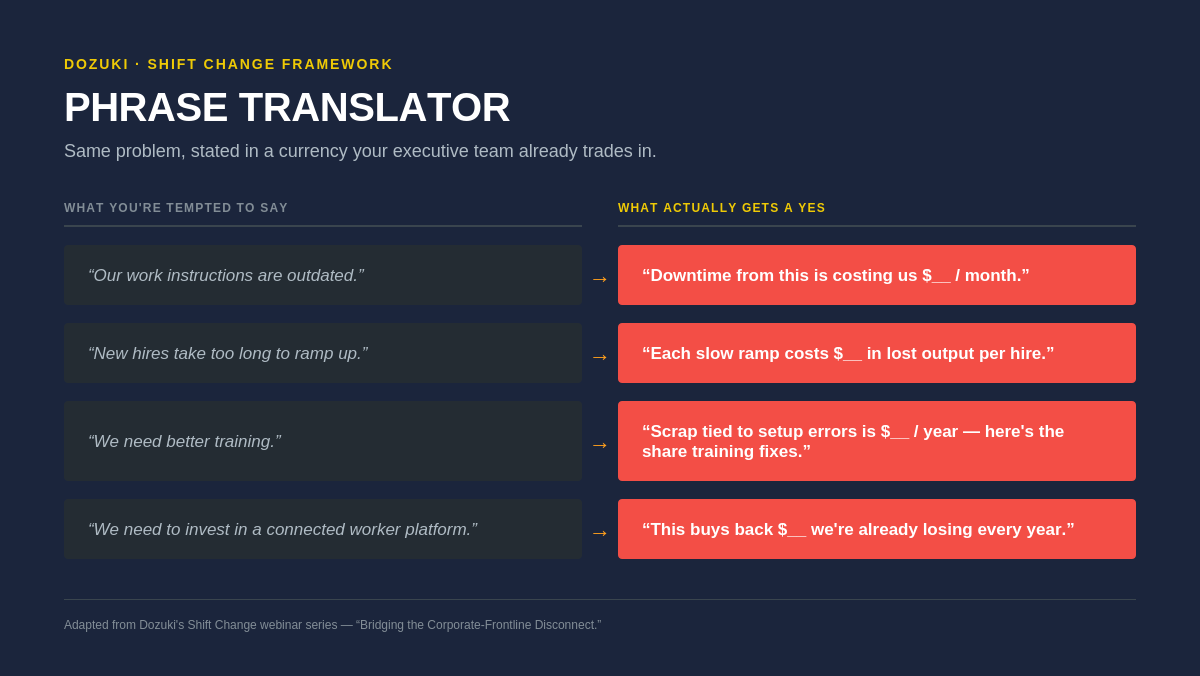
None of this requires a new transformation initiative or a bigger ask than what's already on the table. It requires:
- Picking one thing you can measure, a specific scrap number, a specific downtime pattern, a specific changeover time. Not “productivity” in the abstract; a CFO has heard that word a thousand times and it means nothing to them anymore. “Scrap is $3 million and I can cut it by half” means something, because they know exactly what $10 million of raw material costs.
- Doing the math before the meeting, the $45-minutes-to-$1.5-million conversion isn't hard, but almost nobody does it out loud before walking into the room.
- Finding your sponsor, the person whose core metric you're actually moving. If their number is OEE, connect your fix to OEE explicitly. Don't make them guess how a documentation project relates to a number they report to the board.
- Leading with before and after, not the process, the pitch that actually changes a career is often a single two-column slide: here's what it cost, here's what it costs now. Everything else is backup material for questions, not the headline.
Executives aren't wrong to think in numbers instead of anecdotes, that's the job. The frontline isn't wrong to know more about what's actually driving the number than anyone in the boardroom does.
Do the translation, and you stop being the person explaining TSA lines to someone who's never seen one.
Translate The Problem Into Dollars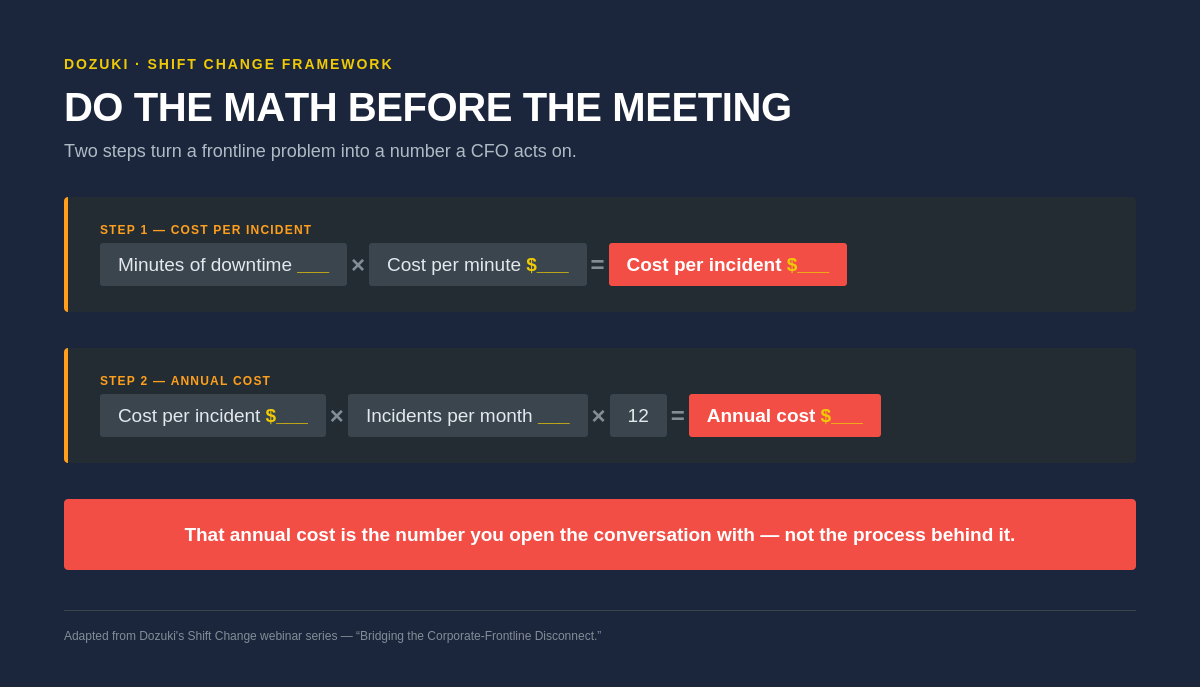
Take this into your next meeting, everything above, condensed into a worksheet you can fill in with your own numbers before your next plant review or budget conversation.
Remember, the organizations that win are the ones that translate frontline improvements into the financial outcomes executives are already trying to achieve.

Written by Scott Ginsberg
Scott is the Content Marketing Manager at Dozuki. He’s spent 20+ years writing books about wearing nametags, conducting corporate training seminars on approachability, and leading knowledge management programs at tech startups. Text him right now at 314.374.3397 with your favorite emoji.