


.png)


The manufacturing landscape is diverging into two distinct groups: those who treat operational knowledge as a static obligation and those who leverage it as a competitive advantage.
For executives in highly regulated industries like medical devices, pharmaceuticals, and aerospace, this divergence is not just about efficiency. It is about the survival of your operational integrity.
While the leaders of 2030 are investing in a connected workforce, organizations accepting the status quo are unknowingly accumulating knowledge debt. Without a modern approach to knowledge management, this debt eventually leads to catastrophic process failure.
The Silent Crisis of Knowledge Decay
In regulated environments, the gap between your paper standard and shop floor reality is where risk lives. Traditional manufacturing SOP systems, such as manual binders, scattered PDFs, and informal job shadowing, are failing to keep pace with modern production demands.
- Knowledge Loss as a Line Item: When a veteran operator retires, they take decades of tacit knowledge with them.
- The Compliance Bottleneck: Relying on outdated manufacturing SOP formats can take days to verify, creating a lag in visibility that keeps you reactive rather than proactive.
- Training Fragility: Standardized training should not be a one-time event. Without automated retraining triggers, your workforce is always one process update away from non-compliance.
The Connected Worker Advantage
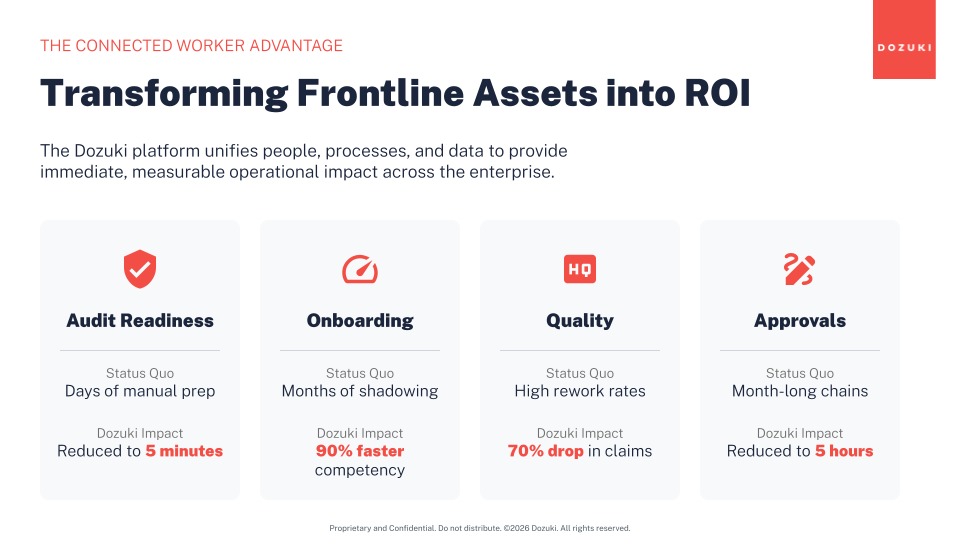
The Dozuki platform provides the digital infrastructure to transform your frontline from a liability into a strategic asset. By replacing static manuals with standardized work instructions, leaders are seeing immediate, measurable ROI:
Proven Results in Regulated Environments
Leading organizations are moving away from manual documentation to secure their future. Here is how that transformation looks in practice:
- Audit Velocity (Global Energy Leader): A Fortune 500 firm in the energy sector moved from three days of manual audit preparation to just 5 minutes. By enforcing standardized work instructions, they eliminated the last minute scramble and maintained a permanent state of audit readiness.
- Accelerated Competency (Medical Device Manufacturer): A large scale medical device manufacturer reduced time to competency from 90 days to just 21 days. They replaced dense, text heavy documents with visual, digital workflows that meet strict FDA regulated standards.
- Risk Mitigation (Specialty Automotive): By building quality directly into their standardized work instructions, a leading mobility provider saw warranty rates drop from 18% to 1%. They turned a massive quality liability into a predictable, standardized process.
Built for Regulation, Designed for the Floor
Unlike generic systems, Dozuki is digital work instruction software specifically designed for the rigors of the factory floor and the requirements of the FDA, ISO, and NIST.
- Software Validation Program (SVP): Automate the software validation process with risk based testing protocols aligned with 21 CFR Part 11.
- Change-Aware Protocols: Prevent outdated execution by requiring workers to acknowledge summarized changes before they can access a procedure.
- Structured Skills Validation: Combine digital quizzes with over the shoulder trainer assessments to prove proficiency, not just awareness.
Stop the Knowledge Drain
Accepting the status quo is a choice to fall behind. The leaders of 2030 are already modernizing their knowledge management by moving beyond static documentation to dynamic, AI driven insights that secure their competitive edge.
Is your operation ready for the next decade, or are you still relying on 20th century binders to solve 21st century challenges?


Written by Scott Ginsberg
Scott is the Content Marketing Manager at Dozuki. He’s spent 20+ years writing books about wearing nametags, conducting corporate training seminars on approachability, and leading knowledge management programs at tech startups. Text him right now at 314.374.3397 with your favorite emoji.