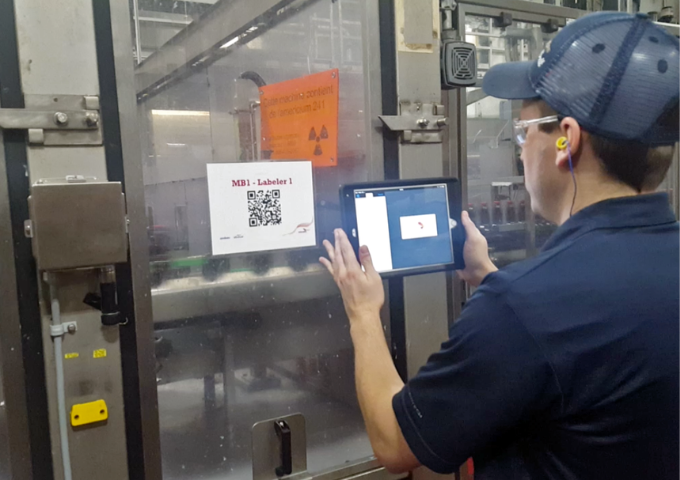
While Manufacturing Execution Systems (MES) are essential for data orchestration and machine-level control, they were never designed for the person wearing the gloves.
For manufacturing leaders, the gap between "System of Record" (MES) and "System of Work" (The Frontline) represents a significant risk to throughput and quality. The MES provides a view from 30,000 feet. However, on the frontline, rigid MES architecture creates friction that slows down frontline work and obscures real-time reality.
Dozuki provides the modern, AI-powered human interface that MES lacks. We transform rigid process enforcement into dynamic worker enablement by unifying work instructions, real-time training, and frontline tribal knowledge into a single mobile-first platform.
| The Reality | The Inaction Penalty | The Dozuki ROI |
| Replacing a single frontline worker ranges from $5,000 to $15,000 in recruitment and lost productivity. | Without a digital “Knowledge Layer” new hires take 3-6 months to reach full proficiency. If they feel unsupported by clunky, outdated tech, they leave within the first 90 days. | By cutting time-to-proficiency by 50% you recoup thousands in labor value per head and stabilize your headcount. |
| 70% of errors are attributed to human factors, often because the worker was following an old version of an SOP or didn’t understand a text heavy instruction. | A single batch failure or a major quality recall can cost millions. If your MES doesn't support video and photos, you are gambling on the operator's interpretation of a text string. | Moving to visual, AI-verified instructions typically reduces "human-error" scrap costs by 15–30% in the first year. |
| Process engineers spend up to 40% of their time updating documentation, answering how-to questions from the floor, and troubleshooting manual data entry errors in the MES. | You are paying six-figure salaries for engineers to act as librarians. This prevents them from working on high-value strategic continuous improvement projects. | By empowering operators to author content and using AI to draft SOPs, you return hundreds of hours to your engineering teams to focus on OEE-driving innovations. |
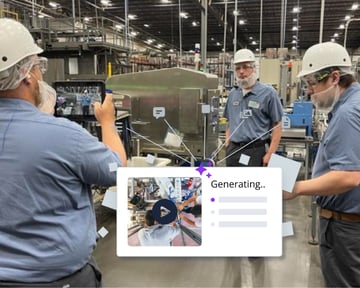 MES platforms operate as rigid frameworks, great for orchestrating process flow, but weak for enabling human knowledge and execution.
Instructions are often coded by engineers, disconnected from tribal knowledge or real frontline insights.
The Result
fragmented content that is not reflective of the “tribal knowledge” that actually keeps operations running during a shift change or material variance.
The Connected Worker Advantage
Dozuki enables your best operators to capture insights, photos, and videos in real-time. You aren't just following a process; you are capturing the expert way and scaling it across shifts instantly, accelerated by AI-powered digitization tools.
The Friction
MES platforms treat work instructions as static data fields. Updating a process often requires a ticket to IT or an Engineering change order that can take weeks.
The Operational Risk
In a high-pressure environment, if the instructions don't match the current reality of the materials or machines, operators stop looking at the screen. This leads to "autopilot" errors and safety deviations.
The Connected Worker Value
Agile Content Management allows for "Bottom-Up" improvements. If an operator spots a more efficient way to stage materials, they can flag it, and Engineering can review and approve the update in minutes, not months.
 The Friction
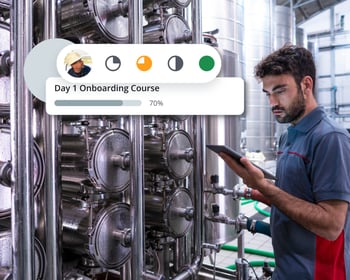
Most MES systems assume the user is already an expert. They track output, but they don't provide instructional support. Training usually happens in a separate LMS or a classroom, disconnected from the actual moment of work.
The Operational Risk
New hires are often "thrown to the wolves," leading to high scrap rates and safety incidents during the first 90 days. You cannot scale a workforce if your MES requires six months of mentorship to master.
MES confirms whether a task was followed, not whether the person was trained, skilled, or ready. It doesn’t evaluate who should run a task, just that the task was done.
Dozuki Learning Pathways ties skill matrices, qualifications, and observed sign-offs directly to SOPs, so only qualified workers are scheduled, and compliance isn’t just logged, it’s proven.
The Friction
Traditional MES is tethered to fixed industrial PCs or "Blue Screens" that require the operator to walk away from the machine to log data.
The Operational Risk
This walk time is non-value-added waste, fixed terminals are rarely updated with the friendly interface found in modern tech, leading to low adoption and data entry errors from workers.
The Connected Worker Value
A native mobile interface, built for tablets, wearables, and offline use, moves with the worker. By putting the brain of the operation in the worker’s hand (via high-resolution multimedia and AI-search), you eliminate the friction of data logging and maximize wrench time.
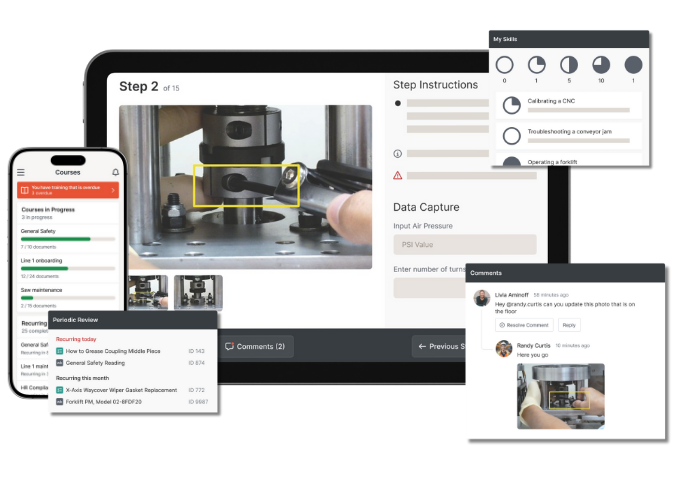
While the MES tracks the machines, a Connected Worker platform uses AI to track and enable the human layer of operations.
Machine signals are not human signals. MES tracks cycle times, machine states, and production flow. But it doesn’t capture the why behind a deviation, or the how behind human-led adjustments.
MES misses frontline feedback, manual checks, missed steps, workarounds, and opportunities for improvement. Dozuki closes this gap by capturing real-time observations, operator comments, in-process checks, and continuous improvement signals.
| Capability | Traditional MES | Human Connected Worker Layer (Dozuki) |
| Primary Purpose | Process execution and machine orchestration | Guide human work, capture knowledge, verify proficiency |
| Knowledge Transfer | Lost with labor turnover | Captured and scaled with video and AI-powered conversion tools |
| Content Creation | Hard coded by engineers with text-only | Author, update, and control SOPs in purpose-built platform |
| Version Control | Limited or external flows slow it down | Built-in with audit trails and approval workflows |
| Process Updates | IT-dependent and can take months to rollout | Operator-led and can take minutes to standardize for proper review and approval routing to engineering teams |
| Competency Tracking | Not native | On-the-job and accelerated with digital standard verification for skills tracking and visibility in skills matrix |
| Root Cause Analysis | Quantitative only - the “what” | Qualitative context - the “why” - allowing for easy scaling of fixes |
| Mobility and Access | Desktop, fixed terminals | Mobile accessible via tablets, offline-friendly, worker friendly interface |
Analysts describe the Connected Worker as the “human layer” of digital transformation. Where MES orchestrates machines, Connected Worker Platforms orchestrate people, knowledge, and execution quality.
With the Dozuki Connected Worker Platform:
Digital work instructions with media, step checks, and e‑signatures
Integrated document control & approvals (change aware, audit‑ready)
Real-time execution guidance with mobile access
Skills matrix management, and proficiency evaluations tied to actual tasks and certifications
In‑process data capture (quality checks, deviations, observations)
Continuous improvement workflows (operator feedback, kaizen loops)
Integrations to MES/CMMS/LMS/HRIS for full visibility into operations
The winning architecture is both MES and Connected Worker Platforms. Keep the MES layer and add a Connected Worker layer that connects key machine data and processes with a frontline-friendly interface and feedback loops.
90 Days to Frontline Digital Transformation:
Traditional MES is great for static operations where the frontline does not need access to process critical information.
Connected Worker Platforms are essential for procedures, proficiency, and performance on the floor.
Use this checklist to help verify if your current MES is solving for frontline usability gaps:
Are we authoring and updating SOPs directly in the flow of work?
Can we verify who is qualified, not just who completed the task?
Do we enable operator feedback and Kaizen loops?
Is our frontline guidance mobile, accessible, and easy to update?
Are our operators empowered, or just following steps?


.png)