


.png)


Industrial leaders are no strangers to change. New machinery, new regulations, new competitors, these are constants But the last decade has brought a different kind of shift: the workforce has transformed.
Updated on [4/1/26]
Where manufacturers once relied on decades-long tenures, deep apprenticeship programs, and a slow pace of operational change, they now face high churn, low tenure, and rapid skill decay.
According to LNS Research, over 50% of organizations have deployed Connected Frontline Workforce (CFW) applications at enterprise scale that include learning, real-time data, decision support, and persona-specific content.
The best performing manufacturers have already made connected work an operational standard.
The question is no longer if you’ll adopt this model, it’s when, and whether you’ll do it in time to keep pace.
The Breaking Point of “The Old Way”
The traditional frontline management model looks like this: Tribal knowledge is passed from veteran to rookie. Onboarding is treated as a one-time event, often delivered via paper binders. Training is viewed as a cost center rather than a performance driver. Quality and safety standards are enforced reactively.
In a stable, experienced workforce, this model could limp along. But today’s conditions make it a liability.
Turnover rates in manufacturing tops 40% annually. Average tenure has dropped below three years in many plants. Institutional knowledge loss is accelerating as Baby Boomers retire, often taking decades of undocumented know-how with them.
The Competitive Gap
The gap between leaders and laggards is widening. Leaders build digital infrastructure for training, execution, and improvement. They capture and structure knowledge as a core asset. They use data from the frontline to drive change in days, not months.
Laggards still rely on paper or static files for SOPs. They have no version control, and workers often guess which process is correct. They struggle to scale training and improvements across shifts, lines, or plants.

Why: The Case for the Connected Worker
The case for connected work isn’t theoretical, it’s urgent, and it’s backed by measurable business impact.
Gartner's recent report on Connected Factory Workers showed organizations where frontline workers feel equipped to succeed and cared for are 2.7x more likely to outperform on business goals.
So what forces are reshaping the industrial workforce?
Demographic shifts, for one, with nearly 25% of the U.S. manufacturing workforce now 55 or older. Labor scarcity is growing, with open positions outnumbering available skilled candidates in multiple sectors. Complexity is also increasing. Products, processes, and compliance requirements are evolving faster than traditional training models can keep up.
Case in Point: Airstream
Facing 94% churn in the first year, Airstream replaced informal “shadow training” with digital, role-based onboarding with the Dozuki Connected Worker Platform.
The Result: Retention stabilized, new hire turnover dropped by 83%, quality scores improved, and ramp-up time dropped. Watch the full webinar here, or this snippet below.
Operational Drag from Disconnection
Disconnected workers cost more than just lost labor.
They lead to lost productivity, with time wasted searching for answers, waiting for supervisors, or correcting avoidable errors. They contribute to quality escapes, errors that slip past checks due to inconsistent execution. And they increase safety incidents, when procedures are skipped or misunderstood due to unclear guidance.
How Connected Worker Systems Reverse the Trend
When every worker has the right knowledge at the right time, onboarding accelerates. Structured, role-specific learning pathways get workers productive in days, not weeks. Execution becomes consistent, with SOP deviations dropping as guidance is embedded in workflows. Improvement becomes continuous, with feedback loops surfacing issues in real time.
Let's explore several real world results:
- Fortune 100 manufacturer: Digitized and standardized tacit knowledge across 200+ plants
- General Mills: Reduced changeover times by 75% with embedded visual SOPs
- Knox: Unlocked over 2,500 hours of productivity
How: Building Your Connected Worker Platform
The transition to connected work is not about buying a new tool, it’s about designing a repeatable system that closes the loop between training, execution, and improvement.
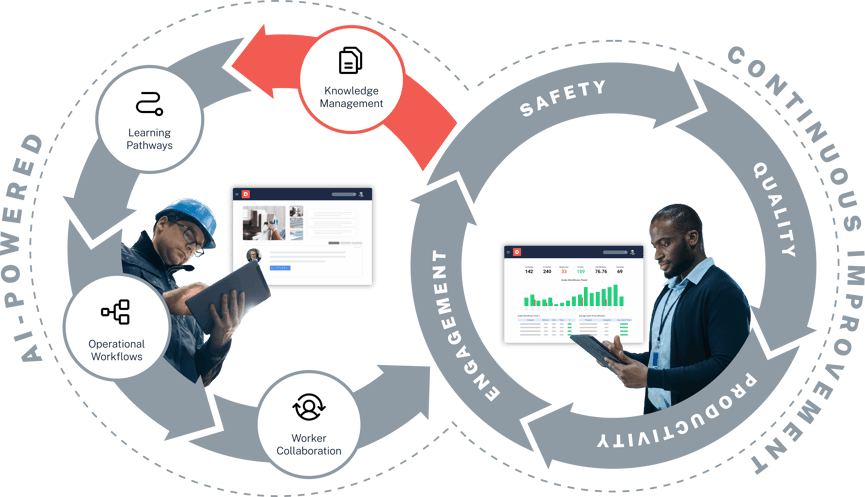
The Inner Loop: Enabling the Worker
At the heart of the Dozuki Connected Worker model is the worker. Our platform ensures every worker is equipped, guided, and engaged.
Every process, work instruction, and best practice is captured in a structured, visual, version-controlled, audit-ready guide. For example, paper-based SOPs are replaced with mobile-accessible visual instructions.
Role-based curricula combine self-paced e-learning, on-the-job tasks, and certification tracking. Compliance training, for instance, is auto-assigned to new hires based on role.
Training flows into live work with interactive digital checklists, built-in visuals, and error prevention prompts. A machine changeover checklist, for example, triggers quality verification before resuming production.
Workers can flag issues, add notes, and suggest revisions directly in the workflow. Someone might flag an unclear step in an SOP, prompting instant review by a supervisor.
The Outer Loop: Driving Business Outcomes
When the Inner Loop runs smoothly, it feeds the Outer Loop. Measurable performance gains across three pillars.
- Safety improves as standard, accessible instructions and automated sign-offs reduce incidents
- Quality improves as step-by-step execution raises first-pass yield
- Productivity increases as faster onboarding and fewer delays keep output high
Most connected worker platforms stop at documentation. Dozuki turns it into a continuous improvement engine.
What a Connected Workforce Looks Like in the Real World
The best way to understand the Connected Worker model is to see it in action. The examples below highlight how manufacturers across industries are using Dozuki to solve frontline challenges and the measurable results they’ve achieved.
Reducing Turnover Through Structured Onboarding
In many manufacturing environments, the first 90 days are make-or-break. New hires face information overload, inconsistent training, and high performance pressure. Without clear guidance, frustration builds and turnover spikes. One paperboard manufacturer faced an alarming 94% first-year churn rate. Each lost employee meant wasted recruitment spend, lost productivity, and increased overtime for remaining staff.
They implemented role-based learning pathways aligned to actual job tasks, along with on-the-job digital guidance to reinforce training in real time.
Supervisors used progress tracking tools to intervene early if a worker struggled. As a result, first-year retention stabilized, ramp-up times improved by weeks, and workers reported higher confidence and engagement.
Standardizing Quality in High-Variance Environments
A large construction firm was struggling to maintain quality across geographically dispersed job sites. Variability in execution led to rework, delays, and compliance risks. Their solution was to roll out project-specific, visual SOPs to all crews. These were made accessible via mobile devices so that step-by-step guidance was available on-site.
They also enabled instant issue reporting with photo attachments. The firm saw a significant reduction in defects, improved audit readiness, and faster resolution of field issues.
Accelerating Compliance and SOP Creation at Scale
At a high-volume Blue Buffalo facility, teams were building SOPs manually in Word, a slow process that often produced inconsistent training experiences across shifts. Facing rapid growth and rising compliance demands, they needed a faster, more scalable solution.
With Dozuki, they reduced SOP creation time by 98%, cutting the process from over four hours to under ten minutes. Standardized documentation improved audit performance by 75%, while version control and feedback workflows increased traceability by 50–80%.
Who: Getting Organizational Buy-In
No Connected Worker initiative succeeds without broad, cross-functional alignment. This isn’t just an Operations project, it’s a cultural shift. The question is, who owns the initiative?
Operations drive process consistency and throughput. Quality gains better compliance and defect prevention. HR and Training reduce turnover and accelerate onboarding. Continuous Improvement uses frontline data for faster problem-solving. IT and Digital Transformation ensure platform scalability and integration.
To gain support, you have to speak people's language. Tie Connected Worker outcomes to department-specific metrics. Operations leaders care about increased throughput and fewer stoppages. Quality teams prioritize lower defect rates and higher audit scores. HR wants reduced turnover and shorter time-to-competency. Safety teams focus on reduced incidents and streamlined compliance reporting.
According to Gartner, 86% of respondents agreed that their leadership understands and sees the need to invest in smart manufacturing. So the appetite is there, but you must connect leadership’s vision to a concrete rollout plan.
Choosing the Right Platform
Once you have buy-in, the next challenge is picking a system that won’t stall after the pilot. It's critical to go beyond feature checklists. Many Connected Worker platforms look similar on paper. The difference lies in:
- Content discipline: Structured, visual, version-controlled guidance.
- Adoption: Intuitive for frontline workers, not just management.
- Scalability: Works across plants, lines, and regions without fragmentation.
Questions to Ask a Connected Worker Vendor
Most platforms talk a big game. These questions help cut through the polish and expose whether the system can handle real-world scale, complexity, and change.
Change Management
- What happens when a procedure is updated?
- Can the system distinguish between minor and major changes?
- Does it trigger retraining automatically, or is that manual?
Compliance and Audit Readiness
- Can I prove which version of a procedure each worker was trained on?
- Is there a system for periodic document reviews and automatic alerts?
Frontline Usability
- How long does it take for a new worker to find and follow a guide?
- Can workers give feedback on content directly from the floor?
Integration and Scale
- Does the system support SCORM or third-party training content?
- How are worker skills tracked, and do they link back to actual work execution?
Authoring and Editing
- Can non-technical staff create & maintain standard work instructions without IT’s help?
- What tools exist to simplify media capture and guide formatting?
The Future Is Built on Execution
Technology doesn’t drive performance, people do. But in modern manufacturing, people need the right system to execute consistently, improve continuously, and adapt quickly.
The Connected Worker model isn’t a passing trend, it’s the foundation of competitive, resilient operations. The leaders are already moving. The question is whether you’ll join them now, or scramble to catch up later.
Dozuki gives you the system to get there. From capturing knowledge to delivering it in the flow of work, we turn disconnected teams into continuous improvement champions.
Here are the two final summary paragraphs for your article on the transition to the connected worker model, optimized for SEO and the "Connected Worker" narrative.
The Imperative of System-Driven Operational Excellence
As the manufacturing landscape faces unprecedented turnover and the loss of legacy expertise, the transition to a connected worker platform has become a strategic imperative. Moving away from the "old way" of tribal knowledge and paper binders requires a unified system that digitizes standard work and delivers it directly to the point of need. By replacing static documentation with interactive, visual guidance, manufacturers can eliminate the operational drag caused by disconnection. This approach ensures that every frontline worker (regardless of tenure—is empowered to execute tasks with the precision and confidence required to meet modern production goals.
The long-term resilience of industrial operations depends on the strength of your digital knowledge management software. When institutional knowledge is captured as a live, version-controlled asset, it creates a self-sustaining loop of training, execution, and continuous improvement. A robust connected worker platform like Dozuki doesn't just store information; it transforms how work is performed by providing real-time visibility and closing critical feedback loops. By prioritizing the digital enablement of the workforce today, leaders can bridge the human-tech divide and build a foundation for sustainable growth and a significant competitive advantage in 2026 and beyond.
Frequently Asked Questions
What is a Connected Worker?
A connected worker is a frontline team member supported by digital tools that provide real-time access to training, standard operating procedures, and process updates, right at the point of work. Instead of relying on paper manuals, tribal knowledge, or inconsistent job shadowing, connected workers follow structured, up-to-date digital instructions. This approach ensures they execute tasks correctly, collaborate efficiently, and contribute to continuous improvement, all while reducing risk and increasing speed.
Why is the Connected Worker model replacing traditional training?
Traditional training methods, such as job shadowing and static binders, were built for a slower, more stable workforce. But with high turnover, complex processes, and rising regulatory pressure, these models break down quickly. Connected worker platforms deliver structured, consistent, and role-specific guidance that’s accessible anytime, anywhere. This reduces ramp-up time, improves retention, and ensures every employee is working from the latest version of the standard.
What business problems does a Connected Worker platform solve?
Connected worker platforms solve core operational challenges like high turnover, slow onboarding, inconsistent quality, and knowledge loss from retiring employees. By digitizing and standardizing frontline knowledge, they ensure faster training, more reliable execution, and stronger feedback loops. The result is fewer errors, shorter downtime, better compliance, and a workforce that’s ready to adapt in real time.
How do I know if my operation is ready for a Connected Worker platform?
If you’re facing high churn, struggling to scale training, or dealing with inconsistent execution across shifts or sites, you’re likely past due for a connected worker solution. Readiness isn’t about perfect infrastructure, it’s about recognizing that current systems are slowing you down. Many companies start with a single line or facility, then scale once they prove the model.
What makes Dozuki different from other connected worker solutions?
Dozuki goes beyond content storage or digital training. It’s built as a full lifecycle platform that connects knowledge capture, role-based learning, real-time execution, and frontline collaboration in one system. With AI-powered authoring tools, scalable admin controls, and deep frontline usability, Dozuki doesn’t just digitize work, it transforms how it's executed and improved across the organization.

Written by Scott Ginsberg
Scott is the Content Marketing Manager at Dozuki. He’s spent 20+ years writing books about wearing nametags, conducting corporate training seminars on approachability, and leading knowledge management programs at tech startups. Text him right now at 314.374.3397 with your favorite emoji.