


.png)



How Dozuki empowers training leaders to close skills gaps, accelerate onboarding, and enforce standard work at scale.
Training is No Longer a Department, It's a System
Training leaders in modern manufacturing are no longer simply instructors or LMS administrators. You are being asked to solve deeply operational problems, faster onboarding, lower turnover, skill gaps across three shifts and five languages, and shrinking time-to-productivity for increasingly complex roles. All while experienced workers walk out the door, audits become more intense, and the margin for error continues to disappear.
The problem is not with your people or your processes.
The problem is that most companies are still treating training like a side system.
SOPs are written once and left in binders. Training updates rely on memory. LMS records don’t reflect what’s actually happening on the floor. And without true visibility into version control or task-specific training, learning becomes disconnected from execution. As a result, inconsistency grows. Mistakes multiply. And the pressure falls squarely on training leaders to fill the cracks manually.
At Dozuki, we believe training can’t be an afterthought. It has to be operationalized. That’s what a real Connected Worker Platform does, it embeds training into the work itself, closes the loop between standards and execution, and gives training leaders the ability to scale clarity and compliance with confidence.
The Dozuki Platform:
Where Training Meets Execution
What a Connected Worker Platform Really Means for L&D Leaders
Let’s be clear: not every tool that claims to support connected workers is built for the realities of training in manufacturing.
Dozuki is different. It’s not just about delivering content, it’s about delivering readiness. With Dozuki, L&D leaders finally get a system that closes the gap between training and execution, transforms how frontline teams learn, and scales skill development across roles, shifts, and sites. Powered by Industrial AI, Dozuki helps you create and maintain training that’s current, contextual, and tied directly to performance.
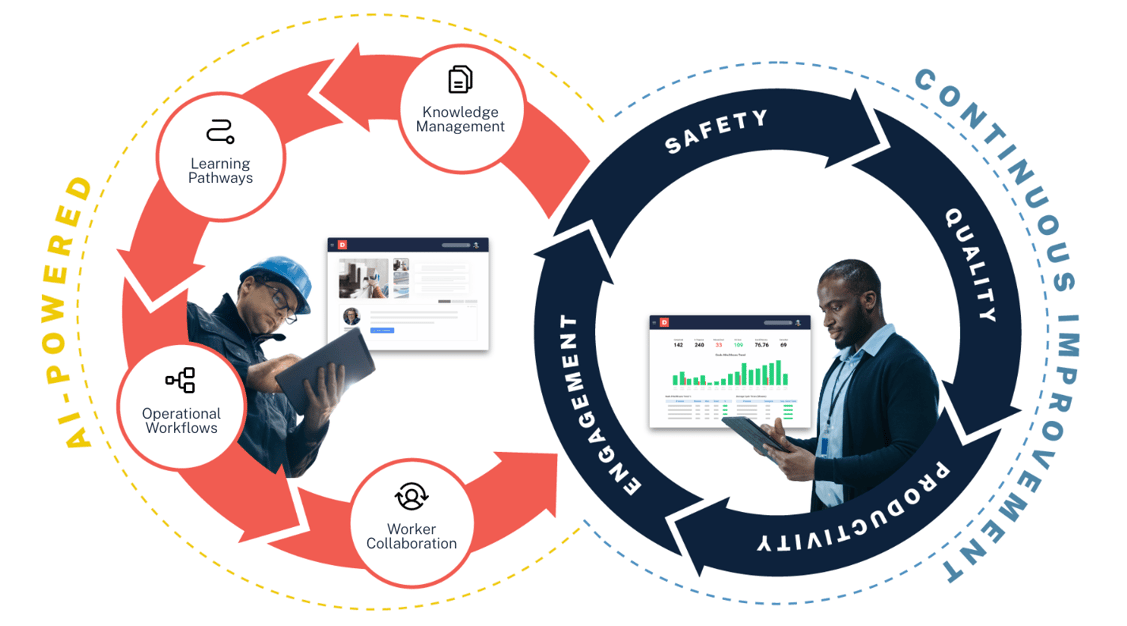
This is what it looks like when L&D drives execution at scale:
AI-Powered Knowledge
Dozuki gives L&D teams a faster, smarter way to capture and scale tribal knowledge. With CreatorPro AI, subject matter experts can record how the work is done, then instantly generate clear, visual instructions without hours of formatting or documentation. These procedures become the foundation of your training system, updated in real-time and aligned with how the job is actually performed on the floor.
AI-Powered Training
With Dozuki Learning Pathways, training isn’t theoretical, it’s operational. Workers move through structured learning experiences that are automatically tied to live procedures, not static content. Quizzes, observations, and trainer sign-offs verify comprehension and prove capability. Training completion isn’t the end goal, proficiency on the floor is.
AI-Powered Workflows
Execution is where training proves its value. Dozuki embeds training into day-to-day work with Operational Workflows that guide, validate, and record how tasks are performed. You gain a real-time view of whether your standards are being followed, and whether your people are truly prepared to follow them.
AI-Powered Collaboration
Dozuki turns your frontline into collaborators, not just trainees. Workers can suggest improvements, flag confusing steps, and share insights as they work. L&D teams can then use that feedback to evolve standards and continuously refine training, closing the loop between learning and performance.
Performance at Scale
As operations grow, training must scale with them. Dozuki centralizes training across roles, shifts, and locations while supporting multiple languages and literacy levels. Every worker gets the guidance they need, every trainer sees who’s ready, and every leader can trust that the floor is aligned to the latest standard.
AI-Powered Improvement
Training doesn’t end with completion, it evolves. Dozuki Industrial AI learns from how your procedures are used, who’s succeeding, and where breakdowns occur. It surfaces risks, suggests updates, and ensures your training content stays current. This turns continuous improvement from a manual effort into a self-sustaining system led by your frontline.
Why SOPs Aren’t Enough Anymore
Standard work is the backbone of any operation, but if it lives in static documents, it's already out of date. Training built on Word files, PDFs, or slide decks may feel sufficient in theory, but on the floor, it leaves too much to chance.
Dozuki transforms those static SOPs into dynamic, visual, and interactive work instructions that live where the work happens. Step-by-step digital guides with images, video, and validation points turn tribal knowledge into a reliable standard. Operators aren’t guessing. Trainers aren’t repeating themselves. And every procedure becomes a lever for performance, not just documentation.
This matters more than ever. When General Mills implemented Dozuki at their Hannibal, Missouri site, they replaced fragile paper-based systems with real-time training built into daily workflows. Training time dropped by 62%, sanitation time tripled in speed, and changeovers became 75% faster, because every worker could follow the exact right steps, every time.
What a Connected Worker Platform Isn’t
Not every tool calling itself a Connected Worker solution is built for the realities of training. Many vendors offer features that look compelling, but fail to solve the real problem of connecting learning to execution.
-
It’s not a chatbot sitting on top of a PDF. Frontline workers don’t need to ask documents questions, they need clear, visual instruction that removes ambiguity in the moment of need. Tools that require conversation introduce friction, not clarity.
-
It’s not an AR headset with a remote expert dial-in. While this can help in niche scenarios, it’s not a scalable training system. You cannot expect workers to strap on goggles to get help with standard work. Training must be embedded, not broadcast.
-
It’s not a video archive dressed up as a platform. Video is helpful, but without structured steps, versioning, and validation, it’s just content, not compliance. Dozuki converts SME-recorded video into structured procedures in minutes, using AI, but never stops at passive viewing.
-
It’s not a skills matrix dashboard with no depth. Checkboxes and pretty UI might impress on the surface, but if you can’t prove who was trained on which version of which procedure, you don’t have defensible training, you have exposure.
The wrong system can add complexity. Dozuki removes it and enforces the behaviors you need to scale.
Onboarding at the Speed of Operations
At Airstream, new hires once received six hours of orientation and were sent directly to the floor, confused, unsupported, and often gone within weeks. Turnover hit 30% among new associates. Training leaders used Dozuki to completely reimagine onboarding: job-specific Learning Pathways, embedded training linked to SOPs, and progress tracking tied to real tasks.
The result? Turnover dropped by 83%, trainer time was reduced by 20%, and onboarding became 12x faster. New hires were building complex assemblies on day one, not month three.
Dozuki doesn't just speed up onboarding, it builds readiness into your daily operations.
The Power of Closed-Loop Training
Training must evolve as the work evolves. When an SOP changes, Dozuki immediately identifies impacted roles, triggers retraining, and tracks acknowledgment. No more email chases. No more wondering if someone saw the update. The system enforces compliance by design.
This closed-loop approach is how Blue Buffalo achieved a 75% improvement in audit scores, and built 98% of their training programs faster. It’s how Costa Farms scaled multilingual training across 9 sites in three languages with zero lag. It's how General Mills survived a retirement wave without sacrificing safety or productivity.
Dozuki makes training traceable, adaptable, and always tied to the current standard.
Built for Scale, Not Spreadsheets
Most training teams have too many responsibilities and not enough time. You can’t afford to chase paperwork across shifts or recreate SOPs every time a process changes. Dozuki is designed for scale: version control, multilingual content, real-time access via QR codes, and content built by your teams, not bottlenecked by IT.
At Costa Farms, frontline workers used to waste seven minutes just locating the right SOP, if they found it at all. Now, they scan a code, choose their language, and start working to standard. SOP access time dropped by 65%. Approval cycles sped up by 80%. And training became a team effort, not a training department burden.
AI That Amplifies, Not Replaces
AI in training isn’t about automation for its own sake, it’s about freeing up trainers to do higher-impact work. Dozuki CreatorPro AI lets subject matter experts document procedures on the floor, using videos or photos, and instantly generates structured training content, no formatting, no editing, no bottlenecks.
This is why Dozuki customers like Blue Buffalo see training builds happen 98% faster. It’s how you stay ahead of change, without burning out your trainers or overloading your SMEs.
AI doesn’t replace the human side of training. It removes the friction so people can focus on what matters.
How to Evaluate a Platform as an L&D Leader
Choosing a Connected Worker Platform isn’t just about ticking off features, it’s about solving the real challenges of training in modern manufacturing. The best platforms don’t just digitize SOPs or store training files. They help you build a workforce that’s truly ready: consistent, compliant, and confident at scale.
If you’re comparing solutions, don’t ask what the platform can do. Ask what it helps your team achieve.
-
Will it reduce retraining time?
-
Will it help you enforce standard work?
-
Will it hold up during audits, turnover, or expansion?
To find a platform that supports your real-world L&D challenges, here’s what to look for:
-
The system must be built for the people doing the work, not just IT teams or digital transformation leads. If it’s too technical to manage without outside help, it won’t keep up with the pace of change on the floor. You need a system that your team can own: intuitive authoring, mobile-friendly access, and SOPs that are easy to update without jumping through hoops.
-
The platform should unify standard work, training, execution, and feedback. These can’t live in separate systems. If training content isn’t tied directly to how the work is actually performed, you’ll end up chasing alignment, and risking inconsistency. The right platform turns every procedure into a living part of your training system, ensuring your workers are always trained on the latest process, not last month’s PDF.
-
You need a platform that can scale with your workforce. That means built-in support for multiple languages, varying literacy levels, and site-specific needs, without creating duplicate content or manual translation workflows. Standardization matters, but flexibility makes it work in the real world.
-
Pay close attention to how AI is used. Some tools layer on flashy features that look good in demos but don’t reduce your workload. Dozuki Industrial AI is built to help L&D teams move faster, by turning floor knowledge into structured guides, translating content automatically, and triggering retraining the moment a procedure changes. That’s real time saved, not extra tools to manage.
-
Fifth, compliance must be baked into the system, not added on later. Look for version control that tracks who was trained on what version of which procedure. Approval workflows should reflect your existing training and quality processes. And retraining should be triggered automatically, not left to chance. If your current process depends on emails or spreadsheets, you're already behind.
-
Finally, demand visibility. Can you see which operators are trained, who needs recertification, and whether training is translating into safe, standard work on the floor? Can you confidently walk into an audit with proof of compliance that maps directly to execution? If not, your platform may be another training repository—not a performance system.
The right Connected Worker Platform makes training operational. Dozuki was built for that purpose, to give training leaders the control, clarity, and confidence to scale capability across a global workforce.
Training Leaders Are Now Operational Leaders
You’re no longer just onboarding new hires. You’re shaping performance. You’re safeguarding compliance. You’re keeping the wheels turning across every shift, every site, and every line. You’re a strategic operator, and you need a platform that acts like one.
Dozuki gives you that. It brings training, standard work, execution, and feedback into one platform, built for how manufacturing actually works. It turns your training programs into operating systems for resilience, consistency, and performance.
When training works, everything else follows.


Written by Scott Ginsberg
Scott is the Content Marketing Manager at Dozuki. He’s spent 20+ years writing books about wearing nametags, conducting corporate training seminars on approachability, and leading knowledge management programs at tech startups. Text him right now at 314.374.3397 with your favorite emoji.