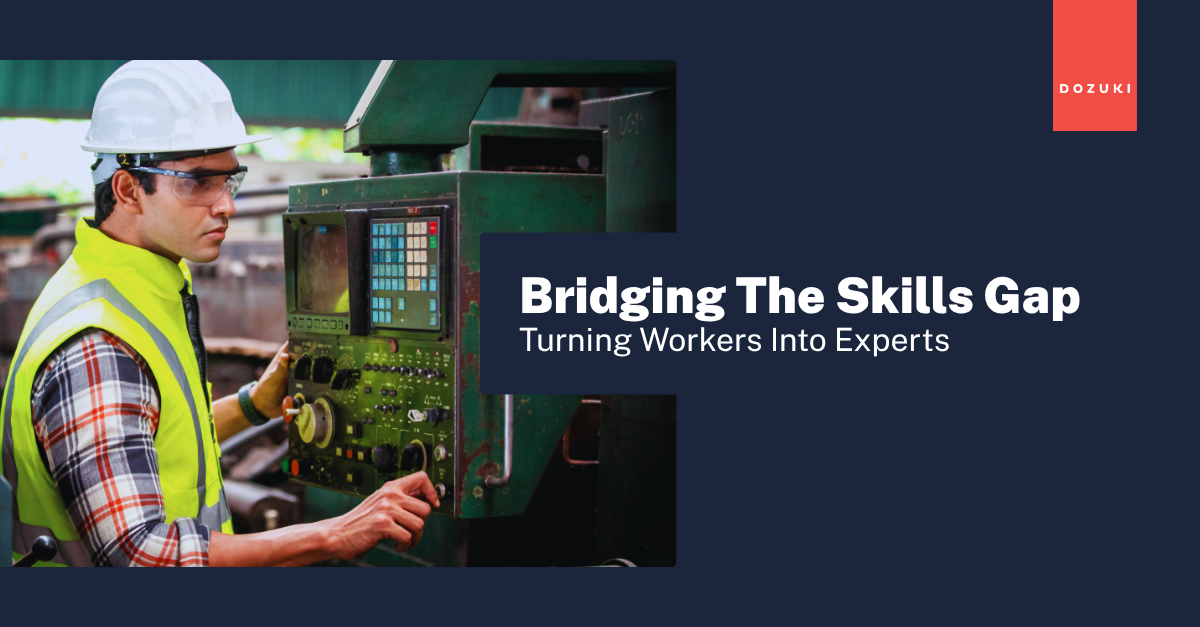
Manufacturing is no longer operating on stable assumptions about tenure. In many sectors, experience cycles are shorter, and institutional knowledge is increasingly fragile. When 47% of a workforce has less than two years of tenure, you’re facing an execution problem.
To survive this shift, organizations must move away from the idea of the "lone expert" and toward a model where every worker is empowered with expert-level knowledge at the point of work. By using a connected worker platform to deliver microlearning and real-time support, you can bridge the skills gap and build a more resilient frontline.
The Failure of the Corporate LMS on the Shop Floor
Most manufacturers try to solve skill gaps with a traditional Corporate Learning Management System (LMS). However, these systems are often disconnected from the reality of the shop floor:
- Passive Learning: Watching a 30-minute video in a breakroom doesn't translate to competency on a high-speed production line.
- Low Engagement: Long, academic modules are often ignored or treated as a "check-the-box" exercise.
- Information Overload: Workers are given too much information at once, leading to rapid skill decay.
Case Study: Land O’ Lakes and the Power of Microlearning
One Dozuki food customer faced a common modern challenge: a rapidly changing workforce where nearly half of their employees had less than 24 months of experience. Traditional training methods weren't sticking, and competency gaps were impacting operational consistency.
By partnering with Dozuki to implement a "microlearning" strategy, they transformed their training culture:
- Bite-Sized Knowledge: They broke complex processes into 2-minute digital modules accessible at the workstation.
- 83% Completion Rate: This was 4x higher than their previous corporate LMS engagement levels.
- Real-Time Upskilling: Workers could learn a new task and execute it immediately, reinforcing retention through action.
Leveraging Industrial AI to Scale Expertise
Dozuki uses industrial AI to help your remaining experts act as a force multiplier for the rest of the team. Instead of an expert spending all their time coaching individuals, they use work instruction software to digitize their "best way" of working.
With manufacturing AI tools, you can:
- Identify Skill Gaps Instantly: Real-time data shows exactly which operators are qualified for specific tasks and where training is needed.
- Automate Retraining: When a process is updated, Dozuki automatically triggers retraining for every affected worker, ensuring the skills matrix is always accurate.
- Standardize Bench Strength: By providing every worker with the same high-quality, visual instructions, you ensure that your "B-team" performs with the same precision as your "A-team."
Building Workforce Resilience
In an era of labor volatility, your competitive advantage is your ability to upskill. Manufacturing knowledge management software is the key to turning a novice into a high-performer in record time.
With Dozuki, you don't just manage training records; you manage human capability. It’s time to stop worrying about the skills gap and start closing it.



.png)