


.png)


The Future of Manufacturing Belongs to the Connected Workforce
How Forward-Thinking Operations Teams Are Reshaping Their Organizations for the Next Decade
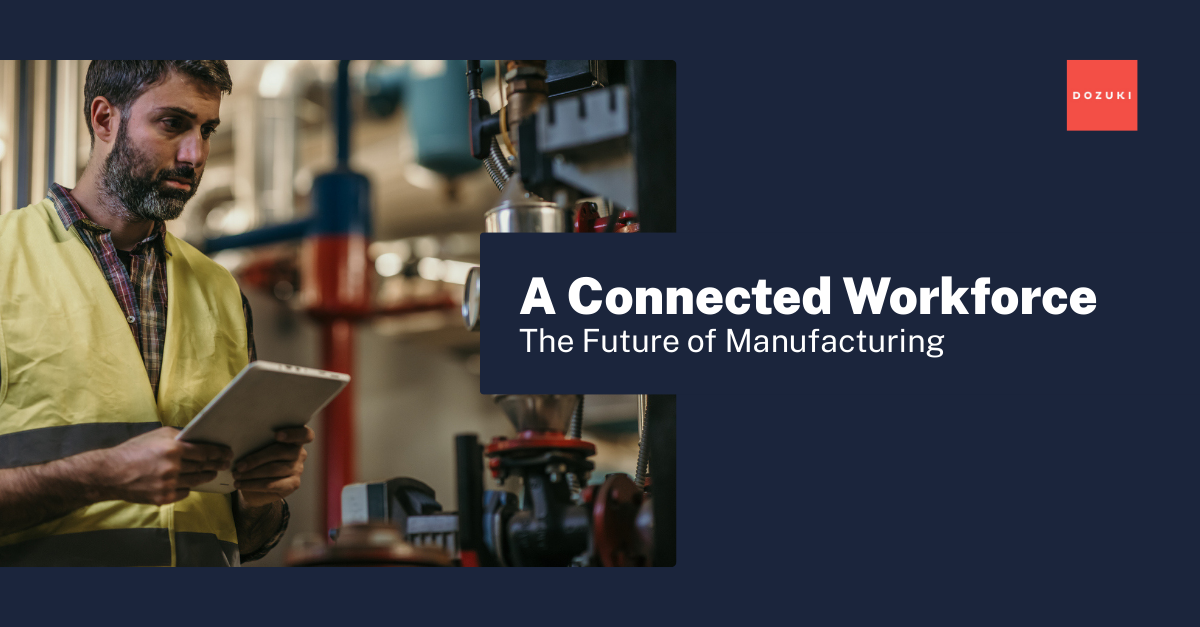
Walk into any high-performing manufacturing operation today, and you’ll see something unmistakable: the role of the frontline worker is changing, fast.
For decades, operational excellence was driven by capital investment, automation, and incremental improvements in equipment efficiency. But as the industry faces a perfect storm of workforce turnover, accelerating product variation, and rising customer expectations, a new reality is taking hold: Th
e next 10 years of productivity gains will come from people—empowered by digital tools that make them smarter, safer, and more capable.
This shift is giving rise to a new organizational model: the Connected Workforce Operations Organization.
And connected worker platforms like Dozuki sit at the center of it.
Why Traditional Manufacturing Structures Are Reaching Their Limits
Legacy operations teams weren’t designed for the volatility manufacturers face today:
- Retiring experts take decades of tribal knowledge with them
- New hires take months to reach proficiency
- Standard work lives in binders or PDFs, outdated the moment the ink dries
- Training is inconsistent, undocumented, and impossible to audit
- Continuous improvement relies on heroic effort instead of real-time data
The organization itself becomes rigid. Good at maintaining the status quo, but slow to adapt. But as manufacturers adopt connected worker platforms, a profound transformation begins.
Enter the Future-State Manufacturing Organization
Connected worker platforms like Dozuki don’t just digitize procedures, they reshape how teams collaborate, learn, and lead. The core structure of an operations organization begins to evolve in three critical ways.
Knowledge Becomes Enterprise Infrastructure
In the future-state model, knowledge is continuously captured, refined, and distributed across sites.
New roles emerge, such as:
- Process Knowledge Engineers
- Content Owners for Safety, Quality, and Maintenance
- Digital Skills & Qualification Managers
These teams ensure the frontline always has access to correct, up-to-date, and role-specific information. And for the first time, leaders gain visibility into workforce readiness across every shift and location.
Training Becomes Continuous
Connected worker platforms shift training from a one-time onboarding event to an ongoing, personalized experience. Imagine a facility where:
- Every employee has a digital learning pathway aligned to their role
- Supervisors see real-time qualification data for every operator
- Recertifications happen automatically based on revision changes
- On-the-job training is guided, verified, and documented
The result? A workforce that gets confident faster and stays competent longer.
Frontline-Driven Continuous Improvement
The future-state operations team no longer treats improvement as a top-down initiative. Instead, intelligence flows upward, powered by structured digital feedback loops.
Operators flag unclear instructions, propose ideas, or capture causes of downtime right inside the workflow. Engineering and CI teams receive actionable insights, not anecdotes.
This closes the loop between: Standard Work → Execution → Feedback → Improvement → Updated Standard
It’s the continuous improvement cycle companies have dreamed of but never been able to operationalize at scale.
The Org Chart of the Future
Forward-looking organizations are beginning to adopt roles and structures optimized for digital operations:
- Director of Workforce Digital Transformation
- Digital CI Analysts
- Knowledge & Standards Managers
- Connected Worker Champions (per site or shift)
- Learning Experience Designers for Operator Onboarding
Traditional functions like Production, Quality, Safety, and Engineering don’t disappear. They become more data-driven, interconnected, and agile.
Each department owns its domain knowledge.
The connected worker platform orchestrates it.
Leadership gains a visibility into operations that they never had before.
The Payoff: A More Capable, More Resilient Operation
Manufacturers adopting the future-state model see dramatic improvements:
- 40–60% faster operator onboarding
- 20-30% reductions in safety incidents
- Higher consistency across shifts and sites
- 40-50% Reduction in frontline turnover thanks to clear career pathways
- 60-80% Higher audit scores and compliance management
- A frontline workforce that can confidently absorb change
This is not merely digital transformation, it’s organizational evolution.
Why This Matters Now
As the manufacturing workforce undergoes generational change and product complexity skyrockets, the companies that thrive will be those that:
- Standardize faster
- Train smarter
- Capture tribal knowledge before it disappears
- Empower their frontline workforce to engage in improvement initiatives
Dozuki enables this transformation by giving operations leaders the tools to modernize their organization without disrupting production.
Manufacturers who embrace the connected workforce model are doing more than implementing new software, they’re future-proofing their operations.
The winners of the next decade will be organizations where:
📌 Knowledge flows freely
📌 Training adapts instantly
📌 Standard work is always current
📌 The frontline has a voice
📌 Leaders see everything they need to run the business
This is the future-state manufacturing organization. And with Dozuki, it's not a distant vision. It’s available today.

Written by Leslie Bloom
The #1 Connected Worker Platform
Trusted by thousands of industrial teams to standardize how work actually gets done. Dozuki turns frontline performance into compounding knowledge and measurable bottom-line impact.
Related Posts
Dozuki Unveils Forge AI: Built for the Next Generation of Industrial Operations
Embedded experiences and a dynamic AI Assistant help manufacturers scale expertise, strengthen workforce capability, and improve operational performance. Dozuki, the leading...
Continue Reading →Connected Worker Platform Use Cases in Manufacturing
Manufacturers are investing heavily in digital transformation, but technology alone does not improve frontline performance. According to Deloitte’s 2025 Manufacturing...
Continue Reading →Connected Worker Platform for Global Manufacturers
For large manufacturers, digital transformation gets harder with every plant added to the network. One facility may rely on experienced operators and paper instructions....
Continue Reading →