


.png)



Understanding the distinction between document management and knowledge management is vital to operational excellence. While the terms can sometimes be used interchangeably, understanding their differences couldn’t be more relevant to the shifting industrial workforce.
What is Document Management?
Document management systems provide essential records and archives for explicit company information. In other words, these systems are information and data management tools that track and store a wide variety of documents. Like digital file cabinets, the content of these file systems are broad and contain current and archived versions.
Document Management - information and data management tools that track and store a wide variety of explicit company information.
As a result, document management systems act as comprehensive data storage and shared file systems. Most commonly used for ISO certification, OSHA, or FDA compliance, these tools assume that the worker already knows which document will address their needs or have the background knowledge to navigate the system.
Personnel with the most interaction with these systems the most are quality control managers, auditors, and HR representatives. Frontline employees looking to solve a real-time problem won’t benefit from these tools because they aren’t designed to retrieve information quickly.
What is Knowledge Management?
An effective knowledge management strategy not only stores and organizes documents, but it also focuses on the distribution and discovery of information relevant to any role. It is a discipline that allows employees to perform better work and solve problems through access to organizational knowledge.
Knowledge Management - a discipline that allows employees to perform better work and solve problems through organizational knowledge.
A knowledge management strategy provides a variety of tools and resources to help employees find information and share knowledge. Unlike document management, there are many approaches and technologies that can assist in the capture, organization, and transfer of knowledge.
Knowledge management also encompasses two distinct categories:
Explicit Knowledge - includes core process, standard operating procedures, and records that are easy to write down and document. Commonly associated with document management systems.
Implicit (tacit) knowledge - the informal “know-how” and experience of your workforce. Knowledge such as troubleshooting techniques and undocumented process improvements are more difficult to capture but far more valuable for operational excellence.
Knowledge management is about making use of both experience and information to create insight, solve problems, and continuously improve. These assets are then distributed across the frontline workforce.
Without proper management, companies will be reliant on the expertise of a few individuals rather than leveraging the entirety of your workforce. Knowledge management strategies create real-time benefits by supporting both employee performance and operational excellence.
What this Means for Manufacturers
As manufacturers face mass retirements, they need to evolve beyond document management and implement an effective knowledge management strategy.
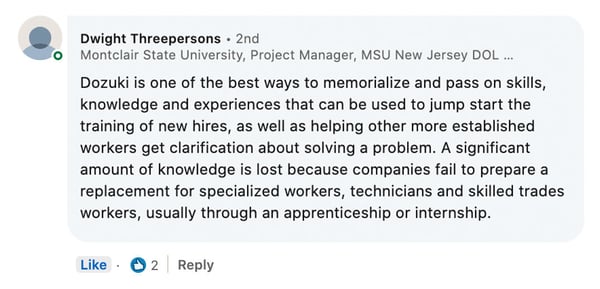
Companies are currently failing to capture the knowledge and expertise of their workforce while being hit with a wave of retirements, also known as the “Silver Tsunami.” A recent survey found that 57% of Baby Boomers have shared less than half of the knowledge needed to perform their job when they retire.
Prioritizing knowledge management is essential for manufacturers to survive current industry challenges by bridging the skills gap and transferring vital information to the next generation. Learning to capture and leverage the expertise of your workforce will not only enable you to survive this generational transition, but improve quality, reduce waste, and boost employee performance.


Written by Dozuki
Dozuki is the leading Connected Worker Platform for industrial operations. Since 2011, Dozuki has helped thousands of manufacturing sites standardize processes, upskill their workforce, and capture real-time data to drive continuous improvement. With a focus on ease of use and enterprise-grade security, Dozuki is the...